Custom Software for SMBs — What Is Possible Now? (2026)
Something fundamental has changed
Imagine: you have a store with 5,000 products. Every day you manually check inventory with your supplier. You copy prices to your website. You process orders via email. You spend more time on administration than on running your business.
That was the situation for one of our clients. Until we built a system in a few weeks that does all of this automatically. Not with an off-the-shelf package. Not with an expensive enterprise solution. With custom-built software, for a fraction of what it would have cost five years ago.
This is no longer an exception. It is the new reality.
Until recently, custom software was something for large companies with large budgets. A simple web application cost €35,000 to €60,000 to build. A complete business system cost hundreds of thousands. For SMBs, that was out of reach.
That has changed. AI has fundamentally accelerated the development process. What used to take weeks now takes days. What used to cost tens of thousands now costs thousands. And the result is not worse. It is often better, because AI tools make fewer mistakes than people working under time pressure.
The numbers confirm this. GitHub research shows developers complete tasks 55% faster with AI tools. McKinsey reports that generative AI makes development work up to 2x faster. Projects that cost €60,000 in 2023 cost €25,000 to €40,000 in 2026 at larger agencies. At agencies that fully embrace AI, like us, business-specific software has become reachable for SMBs. The exact investment depends on scope: a simple automation is a different conversation from a complete business system with integrations.
This article shows what that means in practice. Not with theory, but with real businesses we have helped.
Albendo: from manual work to automation
We visited the tile store of Albendo and proposed building a website. He was not interested. Months later he called back with a specific problem: he had a supplier with thousands of products, but no way to get those products onto his website.
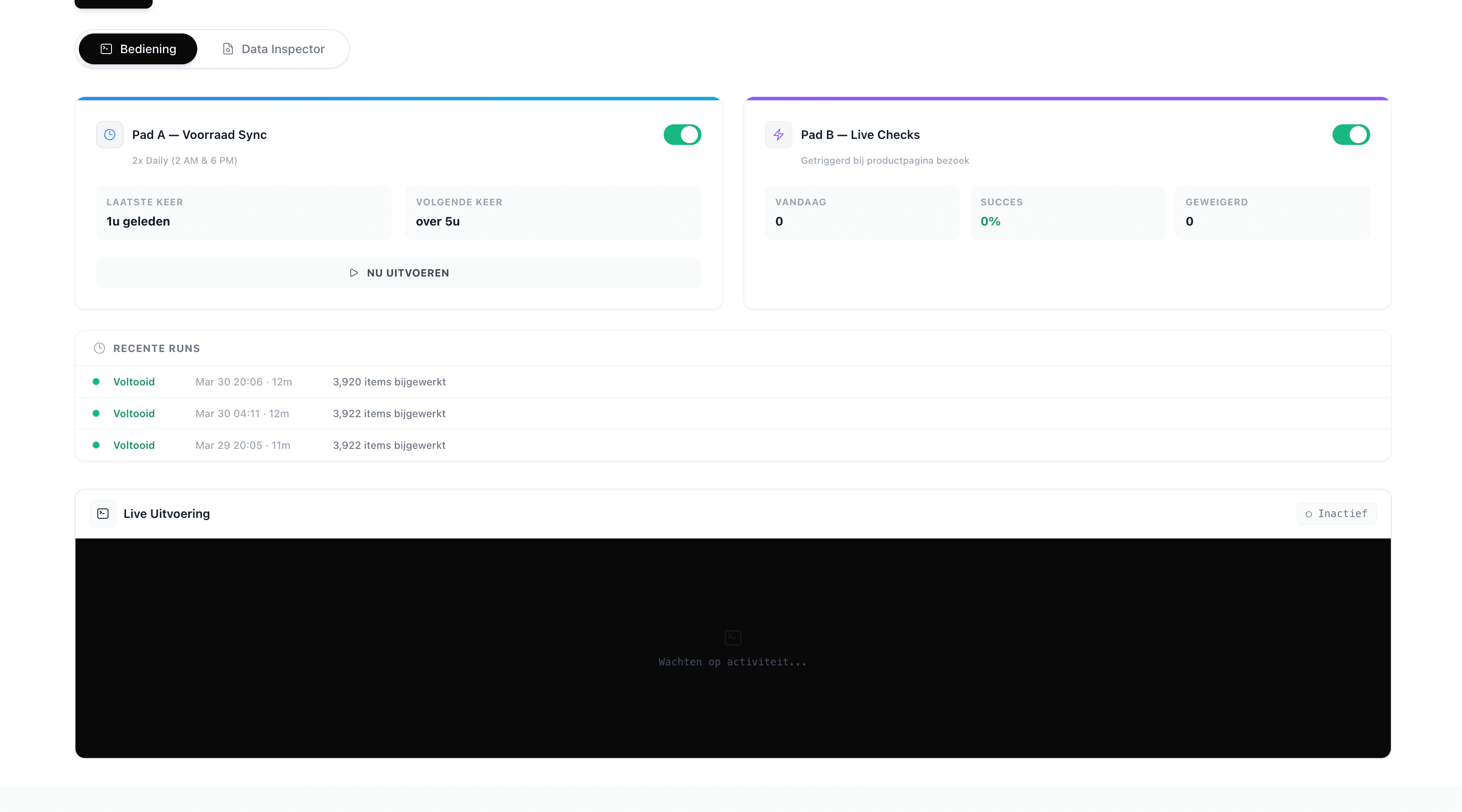
We built a scraper that automatically syncs the supplier's assortment. Daily, more than 5,000 products are updated: prices, inventory, product information. What he used to do manually, the system now handles without him thinking about it.
But it did not stop there. His existing WordPress site was too slow and too vulnerable for this kind of automation. We built a complete custom webshop. The result:
- Thousands of pages indexed in Google (previously he was invisible)
- More orders in the first five months online than he had in the previous two years combined
- Fully automated order processing with automated emails
- Hours per day saved on manual work
The investment? A fraction of what a traditional agency would charge. The payback period? Weeks, not months.
Windmills Sports: a complete management system
Windmills Sports is a sports recruitment agency that connects athletes with universities. Scouts need to browse profiles. Universities need to connect. The team needs to manage everything without it becoming a full-time job.
Try doing that with WordPress plugins or an off-the-shelf package.
We built a custom athlete management system. Creating profiles, updating statistics, uploading photos, all from a single portal. Scouts browse through a professional interface. The team publishes news articles and manages the entire network from the same dashboard.
Previously this took hours per week of manual work. Now it is a matter of logging in, updating, done. The software fits how they work, not the other way around.
Evelyne Fontaine: portfolio management and trip bookings
Evelyne Fontaine is a content creator with more than 50 brand collaborations and an international audience in four languages. She organizes group trips, manages a travel calendar, and needs to present her portfolio professionally to brands.
No standard platform offers this. Not Wix. Not WordPress. Not Squarespace.
We built a platform with three custom-made systems:
- A portfolio manager where she uploads media, fills in statistics, and her work is automatically presented on the website in a format brands can browse directly
- A trip booking system where she creates group trips, manages signups, and easily customizes the page and email flows
- A visual editor that automatically translates to four languages
Everything dynamically connected to the website. She manages her entire business from one dashboard. What would normally require a team and a budget of tens of thousands now runs on software we built in weeks.
What can you automate?
The examples above are specific, but the pattern is universal. If your business does manual work that a system could do faster and more reliably, that is a candidate for automation.
Inventory management and supplier sync. Products, prices, and stock levels automatically updated from your supplier. No spreadsheets, no manual checks.
Order processing. From order to invoice to shipping, fully automated with the right notifications at the right moments.
Customer and contact management. Profiles, interactions, and statuses tracked in a system that fits your workflow, not a generic CRM you use 20% of.
Content and portfolio management. Upload media, categorize it, and automatically present it on your website. No FTP, no manual uploads, no loose files.
Booking systems. Appointments, reservations, or signups managed with automatic confirmations and reminders.
Reports and dashboards. Real-time insight into your revenue, inventory, visitors, or other metrics that matter for your business.
The average SMB employee spends 20 to 30% of working time on administrative tasks that could be automated. In a team of ten people, that equals two to three full-time salaries. The cost of doing nothing is higher than the cost of automating.
Why off-the-shelf tools are not enough
There are thousands of tools on the market. Zapier, Monday, Airtable, Notion, Asana, HubSpot. And for many businesses, they work fine. If you have standard needs, use a standard solution.
But standard solutions have a ceiling. They are built for the average user, not for your specific business. And once you hit that ceiling, you have three options:
- You adapt your workflow to the tool (instead of the other way around)
- You stack tools on tools with Zapier connections that break whenever something changes
- You build what you need
The first option costs you flexibility. The second costs you reliability. The third used to cost you tens of thousands of euros.
That has changed. Read more about what custom software costs in 2026.
The difference between a Zapier automation at €50 per month and custom software is the difference between a band-aid and a solution. Zapier connects tools. Custom software replaces them. It is built for how you work, not for how a SaaS company thinks you work.
This will become the new standard
In the Netherlands, the share of businesses using AI jumped from 6% to 33% in a single year. That is not a trend. That is a shift.
Five years ago every business had a website. Today every business has a website, social media, and email marketing. Five years from now every business will also have custom software running the core of their operations.
The businesses that start now have an advantage that is hard to catch up to. Not because the technology is exclusive, but because the systems you build fill up with data, processes, and optimizations that become more valuable the longer you use them.
Albendo can no longer be caught by a competitor who still orders manually. Windmills Sports operates at a level that cannot be replicated with a WordPress site and an Excel file. Evelyne Fontaine runs an international business with the efficiency of a team three times its size.
The question is not whether custom software will become the standard for SMBs. The question is whether you are early or late.
Want to know what custom software could mean for your business? Request a free strategy report. Within 48 hours we will show you what is possible, what it costs, and whether it makes sense for your situation. Honest advice, regardless of whether you end up working with us.
Frequently asked questions
What does custom software cost for SMBs?
At Nurani, custom software is project-based, with a price that scales with scope. A simple automation is a different conversation from a complete business system. In every case, a fraction of what traditional software agencies charge (€15,000 to €60,000+). The difference: AI has made the development process 55% faster, and we pass those savings on.
How long does it take to build custom software?
Most projects are live within 2 to 4 weeks. A webshop with supplier sync, a management system, a booking platform. The timeline depends on complexity, but you see the full concept before we build it.
Is custom software not something for large companies?
It was. Until AI fundamentally accelerated the development process. In 2026, custom software is as accessible as a professional website. The businesses in this article have teams of 1 to 10 people. They are not enterprise. They are SMBs.
What is the difference with Zapier or other automation tools?
Zapier connects existing tools with rules. If X, then Y. That works for simple automation. Custom software replaces the tools. It is built for your specific workflow, with your logic, without the limitations of a generic platform.
Can I manage the system myself after delivery?
Yes. At Nurani you get a client portal with a visual CMS, analytics, and management tools built specifically for your system. You do not need technical knowledge. You see your changes in real time.
Curious what this means for your business? On a free strategy call we map out exactly where your opportunities lie.
Book a free strategy call