Custom WordPress Website: What Are You Actually Buying?
The short answer
You are searching for 'custom WordPress'. Makes sense. You have probably already noticed that a Wix template is not enough for your business and you want something that actually fits. The problem: what most agencies call 'custom WordPress' is not custom. It is a premium theme (think Divi, Avada, Elementor) with the colors, fonts, and a few layout blocks adjusted. The invoice that comes with it: usually between €5,000 and €15,000.
Real custom is something else. No theme as a foundation, no 20 plugins fighting each other, no annual license fees for functionality you should have owned outright. Custom means code written for your business, not for the 50,000 other businesses that happened to buy the same theme.
And there is another dimension no WordPress agency offers: software that works hand-in-hand with your website. Not separate plugins. Your own client portal with analytics, a visual CMS, and (where needed) business-specific automations. Integrated, not glued together.
In this article we honestly show what you get when you buy 'custom WordPress', how to recognize real custom work, and why the choice in 2026 is different from a few years ago.
What most agencies call 'custom WordPress'
Here is what happens when you request a quote for 'custom WordPress' from an average web design agency.
The agency buys a premium theme (for example Divi, Avada, Astra, or GeneratePress). A professional theme costs €60 to €99 per year. Sometimes the agency uses a page builder like Elementor Pro or WPBakery. Then your branding (logo, colors, typography) is applied through the theme settings. Ten to twenty-five plugins are installed for functionality: contact forms, SEO, security, cookie banner, performance, backups, and more. Finally, the copy is adjusted and your photos are placed.
This whole process is surprisingly fast for the agency. An experienced WordPress builder does it in 40 to 80 hours. At €100 to €150 per hour, the actual production cost lands between €4,000 and €12,000. The invoice you receive? Often the same or more. The margin is not in custom work, because there is no custom work. The margin is in your assumption that 'custom' means something architectural.
Not every agency does this. There are real WordPress builders who construct themes from the ground up with custom code. But that is rare, and those agencies typically charge €15,000 or more. The middle of the market, where most 'custom WordPress' quotes come from, simply does not deliver custom work. That is not an opinion, it is how the market is structured.
Five questions that show you in 5 minutes if it is really custom
Before you sign for 'custom WordPress', ask the agency these five questions. The answers will tell you in five minutes whether you are buying real custom or a dressed-up theme.
Question 1: which theme do you use as a foundation? Real custom answer: 'No theme. We build the design from scratch.' Theme answer: 'We work with Divi, Avada, Astra, or Elementor.'
Question 2: how many active plugins will my site have? Real custom answer: under five, or zero. Functionality lives in the site itself. Theme answer: 15 to 25 plugins for SEO, security, forms, performance, and more.
Question 3: can you show me the Lighthouse score right now of a live site you have built? Real custom answer: 90+ on all four pillars (Performance, SEO, Best Practices, Accessibility). Theme answer: 60 to 80 on a good day. Lighthouse is free and runs in 30 seconds. If they dodge this question, you have your answer.
Question 4: what happens if I disable all plugins? Real custom answer: nothing, the site keeps working as it is. Theme answer: half the site stops working, because the functionality lives in plugins.
Question 5: do I receive 100% of the source code in ownership? Real custom answer: yes, all of it. The code is yours, no licenses, no dependencies on the agency. Theme answer: you have the theme under license, plugins need renewal, and if you leave us you have a technical problem.
There is a sixth signal that rarely gets named: ask what the site does when a visitor arrives via an AI assistant. A real custom site with semantic HTML and schema.org structured data gets cited by ChatGPT, Gemini, and Claude. A theme site with 20 plugins is often too cluttered for AI systems to parse properly. In 2026, that is no longer a nice-to-have.
| Question | Dressed-up theme | Real custom |
|---|---|---|
| Which theme is the base? | Divi, Avada, Astra, Elementor | No theme, built from scratch |
| How many active plugins? | 15 to 25 | Fewer than 5, or zero |
| Lighthouse score? | 60 to 80 | 90+ on all pillars |
| Site works without plugins? | Half the site breaks | Identical to with plugins |
| 100% source code ownership? | No (theme license + plugins) | Yes, all of it is yours |
| Discoverable by AI search? | Limited (cluttered HTML) | Full (semantic + structured data) |
What real custom is, architecturally
The difference between 'custom WordPress' and real custom is not what you see, but how it is built. And that has direct consequences for what the site can do for your business.
A real custom site starts with a blank canvas. No theme, no page builder, no plugins. The design is made for your brand, not adjusted on top of an existing frame. The code is written in a modern framework (Next.js, the same one Nike, Notion, and Hermès use). The infrastructure runs on modern hosting, not on shared hosting where a thousand WordPress sites sit on the same server.
The practical consequences are not abstract.
Speed. A real custom site loads in 0.8 to 1.5 seconds. A WordPress site with 20 plugins loads in 3 to 5 seconds. Google penalizes slow sites in search results. 53% of mobile visitors leave after 3 seconds of loading. Speed is not a technical detail, it is revenue.
Security. A real custom site has no third-party plugins, no unknown code, no licenses that can expire. The vast majority of hacked websites on the internet run on WordPress. Not because WordPress is bad, but because every plugin is a potential vulnerability. With custom, the attack surface is a fraction of what WordPress offers.
Scalability. Want to add a new feature in a year that no plugin offers? With custom, that feature gets built the way your business needs it. With WordPress, you hope a plugin exists, or that you can force one with a combination of four other plugins.
Ownership. With custom, all the code is yours. No licenses, no annual renewal fees, no 'what if the agency does not exist in two years'. Your site is an asset on your balance sheet, not an ongoing expense.
The dimension no WordPress agency offers
Here is the difference the 'WordPress vs custom' debate always misses. It is not just about your website. It is about what is connected to your website.
Most business websites are a digital business card. Pretty, informative, and that is where it ends. But your business does not run on a business card. It runs on processes: tracking inventory, managing customers, processing orders, interpreting analytics, updating content, monitoring suppliers.
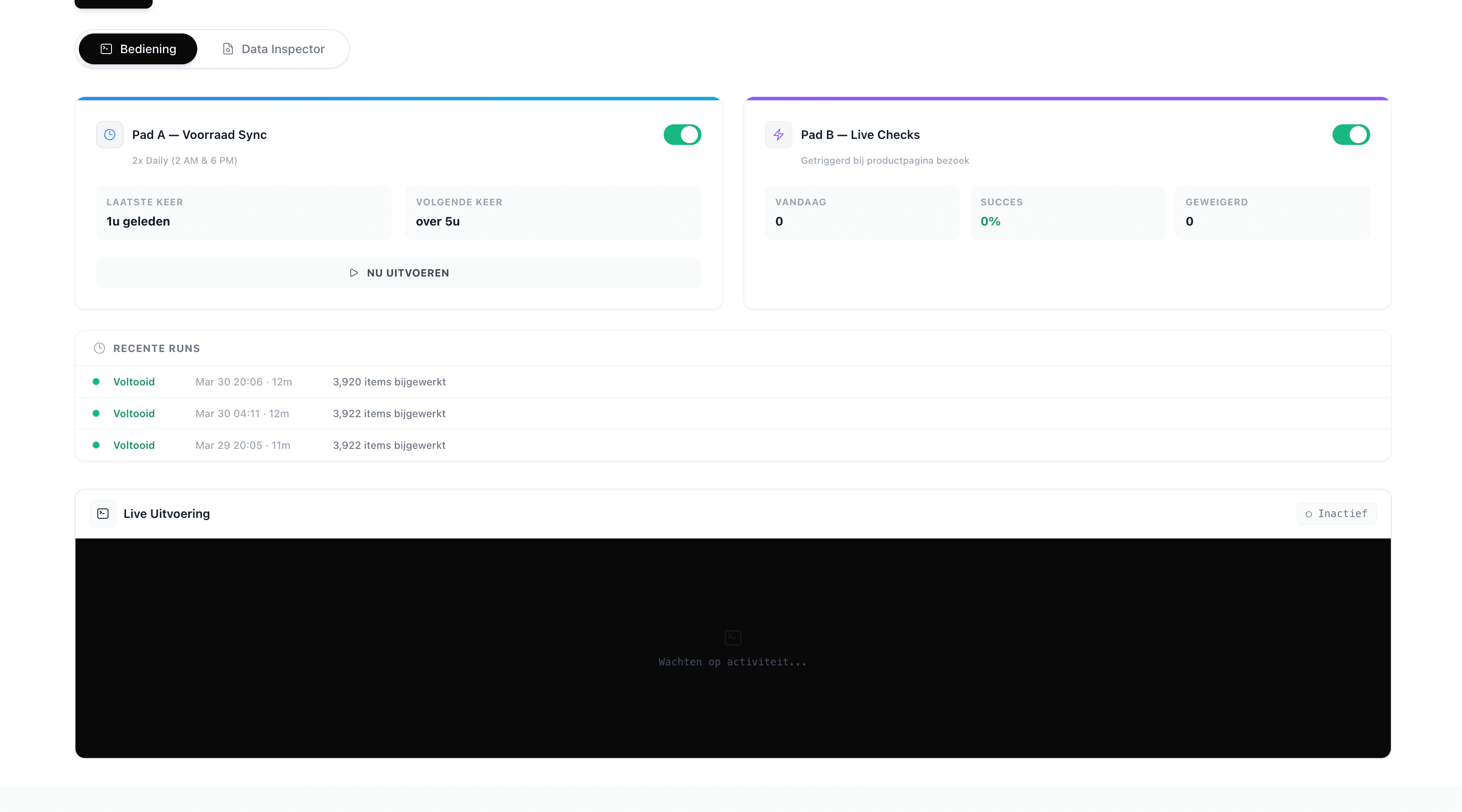
At Nurani, every client gets their own client portal alongside the website. Not as a separate tool, but as an extension of the site. The portal includes by default:
- Real-time analytics, connected to Google Analytics and Search Console - A visual CMS where you edit text and images on your site directly and see the changes immediately - Media management for your photos and videos - For webshops: order management, customer database, product catalog, discount codes - For specific clients: business-specific automations built for their process
That last point is where it really shifts. For a tile webshop, we built a nightly sync that automatically pulls inventory and pricing from the supplier. For a sports recruitment agency, we built an athlete database with scout access. For an international content creator, a visual editor that automatically translates to four languages.
Try this with WordPress. You can partly force it with a combination of plugins. But every plugin is a separate developer, a different update schedule, its own vulnerability. And no plugin does your specific process the way you actually want it. Custom software, by definition, is built only for your business.
Example: how Albendo's webshop gets time back
Concrete example. Albendo sells tiles. Their supplier offers no live API for inventory. Stock changes daily: a container arrives, a batch is sold, a product line is replaced.
With a 'custom WordPress' approach, the solution would look like this: a CSV import plugin at €69 per year, plus a business owner (or employee) who exports a CSV from the supplier portal every morning and uploads it to the WordPress site. Time: 30 to 60 minutes per day. Error rate: high. Scalability: zero.
With Albendo's custom approach, that whole process is gone. A scraper we built for them runs every night, logs into the supplier portal, pulls inventory, prices, and new products, and syncs everything to the webshop. Stock that hits zero gets automatically hidden. New products appear in the right category on their own. Price changes are applied immediately.
Time the owner gets back: about 5 hours per week. Error margin: nearly zero. Scalability: from 5,000 products to 50,000 without the process changing.
This is not a plugin. This is not functionality you can request from a WordPress agency. This is software built specifically for one business, integrated into their client portal alongside their webshop. That is what 'custom' is supposed to mean.
The real bill: WordPress custom versus modern custom
Finally, the math. How do 'custom WordPress' costs stack up, and where is the difference with modern custom?
WordPress custom (from a serious agency) is a stack of line items that add up to the real price:
- Development: €5,000 to €15,000 one-time, sometimes more - Hosting (managed WordPress): €30 to €100 per month - Premium plugin licenses: €300 to €1,500 per year - Maintenance and updates: €100 to €300 per month - Security patches: ongoing, every plugin separately - Plugin extensions for new features: €500 to €3,000 each - Ownership: theme is licensed, plugins belong to others
Over 3 years, that adds up fast: for an average business site, €13,000 to €30,000 or more, excluding the hours you or your team spend on manual work that should have been automated.
Modern custom at Nurani works differently. One project price that fits what we build for your business, and one flat monthly fee covering hosting, client portal, visual CMS, analytics, and maintenance. No plugin licenses, no separate security patches, no surprise invoices for 'small changes'. Business-specific software, like automations and integrations, is built project-based into your portal. The code is 100% yours.
For projects of comparable scope, the 3-year total of modern custom lands meaningfully lower than the plugin-stacked WordPress total. But the real comparison is not about euros. Plugin-based sites stack costs because they depend on external developers and yearly licenses. Modern custom has lower ongoing costs because the architecture is cleaner, and the software we build for you works for you instead of you working for the plugins.
The investment we quote scales with the scope of the project. A simple website is a different conversation from a webshop with automations, supplier integrations, and business-specific modules. What stays constant: you never pay for fluff, and you know what you are getting before you commit.
How to move forward
If you have read this far, you are not looking for the cheapest option. You are looking for something that actually fits your business. Good.
Three closing observations.
One: 'custom WordPress' is almost always a dressed-up template, except at a handful of agencies charging €15,000 or more. The middle of the market does not deliver custom, regardless of what they call it.
Two: in 2026, the choice is no longer 'WordPress custom vs cheap template'. The choice is 'plugin-based site that will be outdated in two years vs modern custom that grows with your business'.
Three: a website in 2026 is only part of the story. What is connected to it, your portal, your analytics, your automations, your integrations, determines whether the website works for you or you work for the website.
At Nurani, we work with the Vision First Protocol. We learn your business first. We develop your strategy. We build the complete concept, including design and functionality. Only when you see it and are happy with it do you pay. No surprises, no deposits based on a quote. The difference between what we make and what a 'custom WordPress' agency delivers, you can judge for yourself.
Request a free strategy report. Within 48 hours you will know exactly what is possible for your situation.
Frequently asked questions
Is WordPress never a good choice?
WordPress works fine for blogs, simple informational sites, or if your budget is genuinely under €1,500. For business websites with growth ambitions, integrations with other systems, or webshops with more than 50 products, you will eventually run into plugin limitations. The question is not whether WordPress works, but whether it fits what your business will need in 2 to 3 years.
How can I tell if an agency really delivers custom?
Ask concretely: which theme do you use as a base, how many plugins will be installed, can you show a Lighthouse score of a live site right now, and do I receive 100% of the source code in ownership. If they dodge or get vague on these, it is not real custom. A good agency answers these questions directly within five minutes.
What if I already have a custom WordPress site?
A rebuild is a one-time investment that eliminates the ongoing costs: plugin licenses, maintenance, security, and customers lost to slow load times. Concrete signs it is time to switch: your site loads slower than 3 seconds, you have already been hacked, or you are paying more than €200 per month on maintenance and plugin costs.
What is the difference between Nurani's custom and the more expensive end of the traditional agency segment?
No quality difference in the website itself. The difference is how we use AI in our process, to listen deeper and build faster without compromising quality. Plus a smaller team and lower overhead. You get the same architecture and quality, at a price that scales with the scope of your project.
Do I really get my own software in the portal?
Yes, for clients who need it. The base portal (analytics, visual CMS, media management, and for webshops order management) comes with every client. Business-specific automations, like Albendo's supplier sync or Windmills Sports' athlete database, are built separately on a project basis. This is where 'custom' becomes more than just a website.
Curious what this means for your business? On a free strategy call we map out exactly where your opportunities lie.
Book a free strategy call